Fiber OLT : what is an Optical Line Terminal ? 2026
Contents
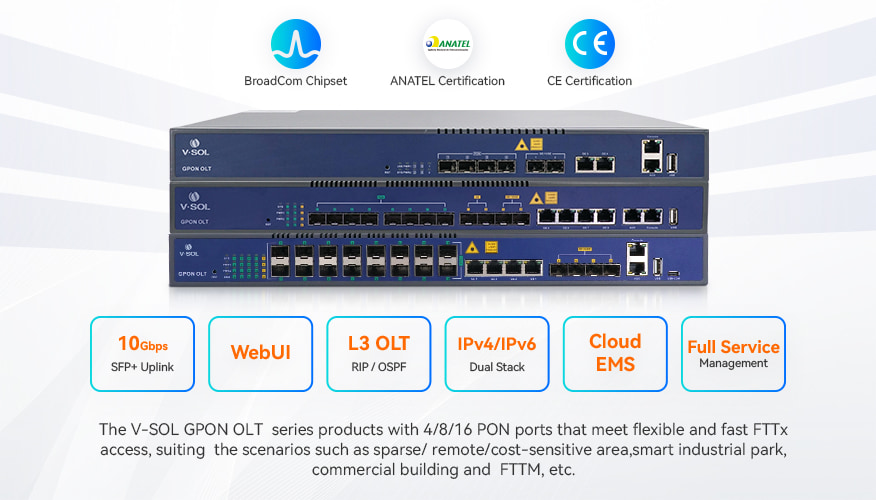
The OLT (Optical Line Terminal) is the cornerstone of any passive optical network (PON). It is the operator-side device that orchestrates communication with the hundreds or thousands of ONU/ONT units on the subscriber side. Without an OLT, there is no FTTH : all fiber sharing, bit-rate control and synchronization pass through it.
Yet it is the least visible piece of equipment : hidden in a NRO (optical connection node) or a building technical room, it nonetheless concentrates the intelligence of the network. This guide details what an OLT is, its components, the types (GPON, EPON, XGS-PON), and how to choose between 4, 8 or 16 PON ports depending on your deployment.
What is an OLT ?
An OLT is an active piece of equipment located on the provider side, typically in a NRO (optical connection node) or an operator room. It :
- Transmits and receives light signals to/from the ONU/ONT units via a passive splitter
- Performs the optical ↔ electrical conversion between the PON fiber and the Ethernet backbone
- Manages dynamic bandwidth allocation (DBA) among the subscribers of the same PON port
- Authenticates each ONU by its unique identifier (LOID, SLID, MAC)
- Monitors link quality, measures fiber distance, and reports alarms
On the operator side : a single PON port of the OLT serves up to 32, 64 or 128 subscribers via a splitter. A single 16-port OLT can therefore serve more than 2000 households.
Main functions of the OLT
- Network-side fiber termination : the OLT connects to the metropolitan network via 10G/40G/100G links. It aggregates the traffic of all its PON ports toward the operator core.
- Optical distribution to subscribers : via a passive 1:8, 1:16, 1:32, 1:64 or 1:128 PLC splitter, the fiber is divided and reaches each subscriber ONU.
- TDMA management : in the upstream direction, the ONU units share the fiber. The OLT assigns each one a time window to transmit, avoiding collisions.
- Distance measurement (ranging) : the OLT automatically computes the fiber length to each ONU to precisely synchronize the TDMA windows.
- Security and QoS : AES-128 encryption downstream, traffic prioritization (VoIP, multicast TV, Internet), VLAN-based access control.
- Management : EMS web interface, CLI, SNMP, TR-069, NetConf for configuration, monitoring and updates.
Internal components of an OLT
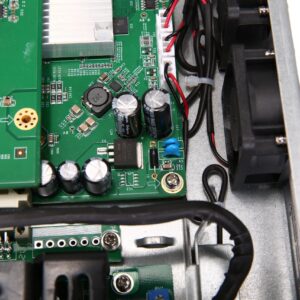
A professional OLT is made up of :
| Component | Role |
|---|---|
| Control card (2x) | Main + secondary for redundancy (active/passive) |
| PON line cards | Carry the SFP/SFP+ BiDi modules for GPON/EPON ports |
| Uplink cards | 10G/40G/100G ports to the backbone |
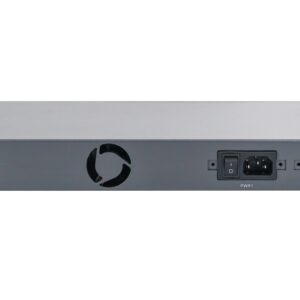
| AC/DC power supply | Dual redundant supply, 220 V AC and/or -48 V DC |
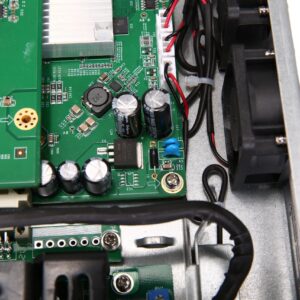
| Ventilation unit | Heat dissipation + environment monitoring |
| 1U or 4U chassis | 19" rackable formats ; pizza-box or modular |
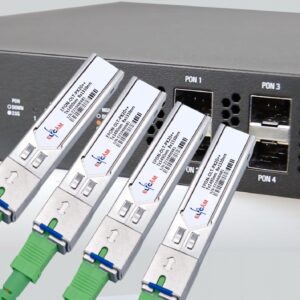
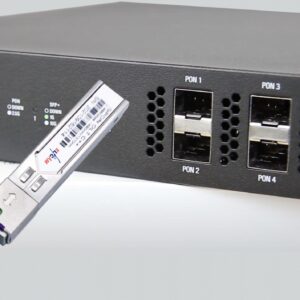
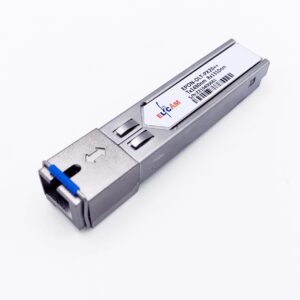
In our range, Elfcam OLTs use SFP BiDi GPON/EPON modules (TX1490/RX1310 nm for GPON, TX1550/RX1310 nm for EPON) to be inserted into the PON ports.
OLT types : GPON, EPON, XGS-PON
- GPON (ITU-T G.984) : 2.5 Gbps downstream / 1.25 Gbps upstream. The dominant standard in France, Europe, USA.
- EPON (IEEE 802.3ah) : 1.25 Gbps symmetric. Historic in Asia (China, Japan, Korea).
- XGS-PON (ITU-T G.9807) : 10 Gbps symmetric. New generation deployed since 2019 in France (Freebox Ultra, Orange Pro).
- 10G-EPON (IEEE 802.3av) : 10 Gbps symmetric, the IEEE-side equivalent of XGS-PON.
- NG-PON2 (ITU-T G.989) : 40 Gbps via 4-wavelength multiplexing. Rarely deployed outside pro/pilot use.
- 25G-PON, 50G-PON : future standards, adoption underway for 2026-2030.
In France, the vast majority of OLTs deployed by Orange, SFR, Bouygues, Free use GPON + XGS-PON in coexistence on the same fiber (wavelength multiplexing). See our dedicated article on the principles of GPON and the full PON family.
Number of PON ports : 4, 8, 16
An Elfcam OLT comes in several configurations depending on the number of subscribers to serve :
| Model | PON ports | Splitting | Max subscribers | Use case |
|---|---|---|---|---|
| GPON 4 ports | 4 | 1:64 | 256 | Small building, village, hotel |
| EPON 4 ports | 4 | 1:64 | 256 | Enterprise POL network |
| GPON 8 ports | 8 | 1:64 | 512 | Residence, university campus |
| EPON 8 ports | 8 | 1:64 | 512 | Industrial campus, luxury hotel |
| GPON 16 ports | 16 | 1:128 | 2048 | Regional operator, city |
| EPON 16 ports | 16 | 1:64 | 1024 | Niche operator, RIP |
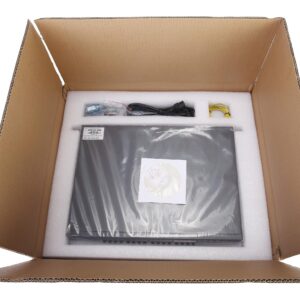
Elfcam OLTs and accessories
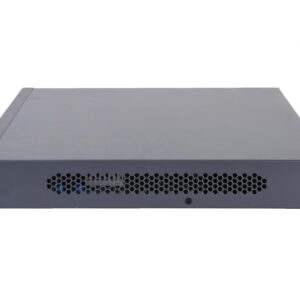
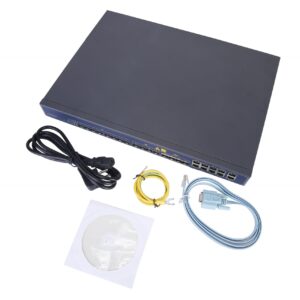
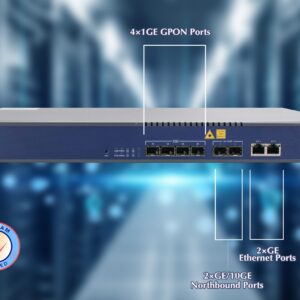
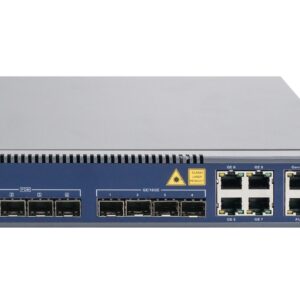
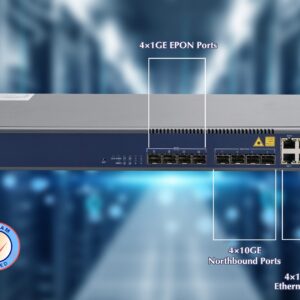
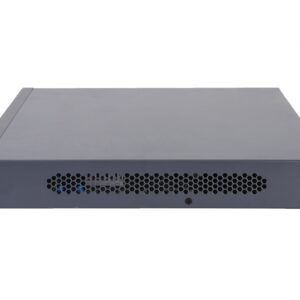
- GPON 16-port OLT — operator up to 2048 subscribers
- EPON 4-port OLT — hotel deployment or POL residence
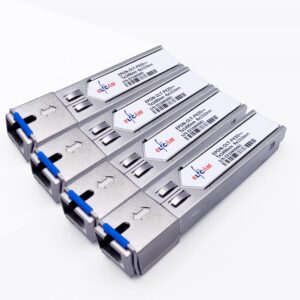
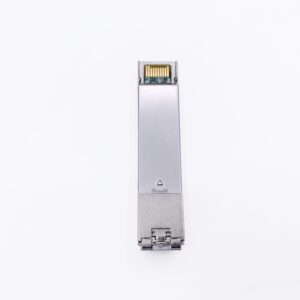
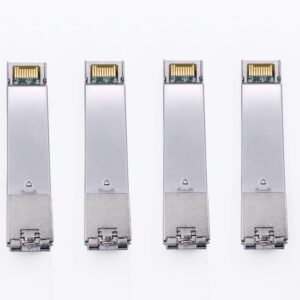
- GPON OLT SFP module PX20++ 1.25G 20 km — to be inserted into the PON ports
- GPON OLT SFP module Class C++ 2.5G 20 km — high power for long distances
- PLC splitters 1:8 to 1:64 — subscriber-side distribution
- Multiple SFP modules — 10G/40G backbone uplink

Typical FTTH application
A concrete example of a complete FTTH architecture for an alternative operator or a RIP (public initiative network) :
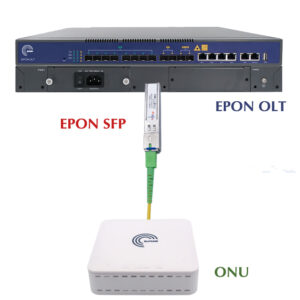
- NRO : the 16-port GPON OLT is installed in a 19" rack with redundant -48 V DC power.
- Uplink : the OLT goes up to the backbone via 2× 10G SFP+ or 40G QSFP+ (collection links).
- Distribution : each PON port feeds a 1:32 splitter in a street cabinet (PMZ / SRO).
- Connection : from the cabinet to each dwelling, an individual fiber reaches the PTO.
- Subscriber terminal : a WiFi 6 HGU or ONT terminates the fiber on the client side.
OLT + POL for hotels and residences
As an alternative to traditional Ethernet cabling, POL (Passive Optical LAN) uses a compact OLT (4-8 ports) in the technical room, splitters per floor, and one HGU per room. It drastically reduces electricity consumption, simplifies adding/removing rooms, and supports Internet + VoIP + TV + connected locks on a single fiber cable.
Criteria for choosing your OLT
- Targeted PON standard : GPON (classic subscribers) or XGS-PON (multi-gig) ?
- Number of subscribers : 4 ports are enough for 256 subscribers at 1:64, 16 ports for 2048
- Required uplink : 10G for a small deployment, 40G-100G for an operator
- Redundancy : dual control card + dual power supply for operator SLA
- Management : proprietary EMS, SNMP support, NetConf, OSS/BSS integration
- Budget : 500-1500 € for 4 ports, 2000-5000 € for 16 ports, depending on brand and licenses
- Support and training : the OLT is not plug-and-play ; it requires VLAN configuration, service profiles, LOID management
FAQ — Everything about the OLT
1Is the OLT a piece of equipment for consumers ?
2What is the difference between an OLT and an Ethernet switch ?
- Ethernet switch : connects devices in point-to-point Ethernet (copper cable or fiber + SFP)
- OLT : connects subscribers in point-to-multipoint PON via a passive splitter
3How many subscribers per PON port ?
- 1:32 : typical of Orange, Free — 32 subscribers per PON port
- 1:64 : common among alternative operators — 64 subscribers per port
- 1:128 : rare, requires XGS-PON to maintain effective throughput
4GPON or EPON for my OLT ?
- Enterprise POL deployments (dominant IEEE ecosystem)
- Asian operators (imports)
- Converted legacy CATV networks
5Does the OLT handle multicast TV (IPTV) ?
6How do I install and configure an OLT ?
- Mounting in a 19" rack with AC or DC -48 V power
- Uplink connection via 10G SFP+ modules
- Insertion of the BiDi PON SFP modules into the PON ports
- Access to the web EMS or CLI for initial configuration (management IP, service VLANs, QoS profiles)
- Declaration of the ONU units (LOID, SLID) and activation per port
- Throughput tests and monitoring via SNMP/NetConf
7OLT redundancy, is it necessary ?
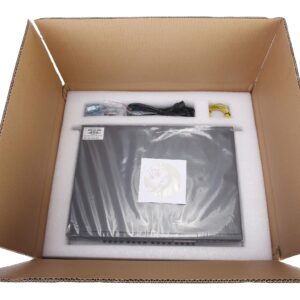
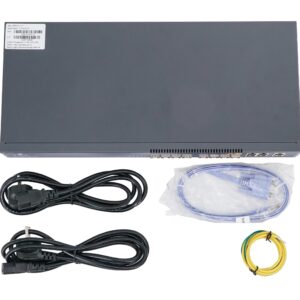
8Elfcam delivery and support for OLT ?
In summary
The OLT is the brain of a PON network : it orchestrates fiber sharing among hundreds or thousands of subscribers. For an FTTH deployment, choosing the right OLT depends on the number of subscribers, the standard (GPON vs EPON), the splitting, the redundancy and the budget.
For a small deployment (hotel POL, campus), a GPON 4-port OLT is enough. For a regional operator or RIP, aim for a GPON 16-port OLT. Complete the chain with SFP PON modules, PLC splitters, fiber patch cords and subscriber-side HGUs.