xPON, EPON, GPON: what are the differences? Complete guide to PON technologies
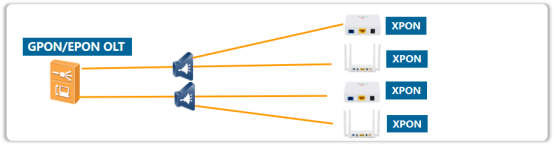
Table of contents
GPON, EPON, XGS-PON, NG-PON2, xPON — the world of passive optical networks is full of similar-looking acronyms that actually refer to distinct technologies. Yet the choice between these standards directly determines the available speeds, compatible equipment and the cost of an FTTH deployment. This guide unravels the essential differences between GPON, EPON and xPON, and explains why the latter has become an essential transition solution.
GPON and EPON are not interchangeable — their protocols, speeds and encodings are fundamentally different. xPON solves this incompatibility problem by automatically detecting the type of network it connects to.
What is a PON network?
A PON (Passive Optical Network) is a point-to-multipoint fiber optic access network architecture. It relies on three main components:
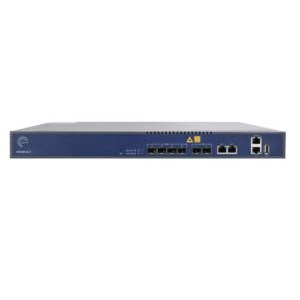
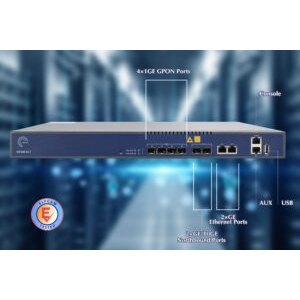
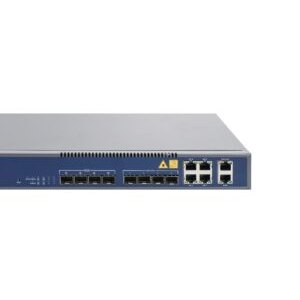
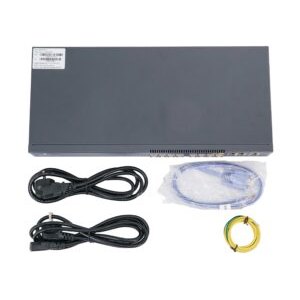
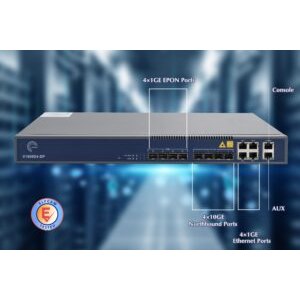
- OLT (Optical Line Terminal) — active equipment located at the operator's premises or in the telephone exchange. It manages the entire PON network and aggregates subscriber connections.
- Passive optical splitter — a fully passive signal divider (without electrical power) that distributes the optical signal between 2 and 128 subscribers.
- ONU/ONT (Optical Network Unit/Terminal) — active equipment installed at the subscriber's premises, which converts the optical signal into a usable Ethernet or telephone signal.
The qualifier "passive" comes from the fact that the splitter requires no power — it simply divides the light power. This architecture considerably reduces infrastructure and maintenance costs compared to a conventional point-to-point network.
GPON — the high-speed reference
GPON (Gigabit Passive Optical Network) is defined by the ITU-T G.984 standard. It is the dominant standard in Europe and in the FTTH deployments of French national operators (Orange, SFR, Bouygues, Free).
- Downstream rate: 2.488 Gbps
- Upstream rate: 1.244 Gbps
- Encapsulation protocol: GEM (GPON Encapsulation Method)
- Maximum split ratio: 128 subscribers per OLT port (typically 32 or 64 in real deployments)
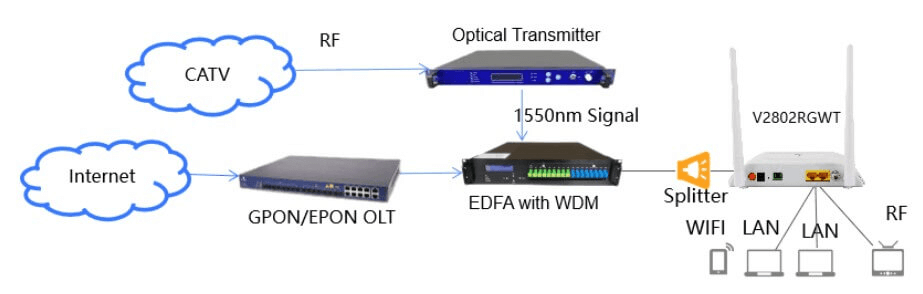
- Supported services: ATM, TDM, Ethernet and CATV (cable television via WDM)
- Quality of service: T-CONT and DBA (Dynamic Bandwidth Allocation) guarantee strict QoS per subscriber
- Wavelengths: 1490 nm downstream, 1310 nm upstream
The advanced QoS of GPON — via the T-CONT (Transmission Containers) — allows it to dynamically allocate bandwidth to each subscriber according to their real-time needs. This is why it is preferred for triple-play deployments (internet + telephony + television).
EPON — the native Ethernet solution
EPON (Ethernet Passive Optical Network) is defined by the IEEE 802.3ah standard. Developed by the IEEE rather than the ITU, it adopts a native Ethernet approach, which makes it easier to integrate into existing IP networks.
- Rate: 1 Gbps symmetrical (10G-EPON per IEEE 802.3av: 10 Gbps downstream / 1 or 10 Gbps upstream)
- Line encoding: 8B/10B (less efficient than the NRZ of GPON)
- Control protocol: MPCP (Multi-Point Control Protocol)
- Supported services: native Ethernet only — no native TDM or ATM support
- Quality of service: DiffServ/802.1p — less precise than GPON's T-CONT
- Wavelengths: identical to GPON (1490/1310 nm)
- Split ratio: up to 32 subscribers (typically)
EPON is more economical to deploy than GPON, particularly thanks to less expensive chips. It is especially widespread in Asia (China, Japan, Korea) and in enterprise installations where native Ethernet integration simplifies network management.
GPON vs EPON — direct comparison
| Criterion | GPON | EPON |
|---|---|---|
| Standardization body | ITU-T (G.984) | IEEE (802.3ah) |
| Max downstream rate | 2.488 Gbps | 1 Gbps (10G: 10 Gbps) |
| Max upstream rate | 1.244 Gbps | 1 Gbps (10G: 1 or 10 Gbps) |
| Protocol | GEM | MPCP (Ethernet) |
| Line encoding | NRZ | 8B/10B |
| Native services | Ethernet, TDM, ATM, CATV | Ethernet only |
| QoS | T-CONT / DBA (strict) | DiffServ / 802.1p |
| Max split ratio | 128 | 32 |
| Equipment cost | Higher | More economical |
| Dominant deployment | Europe, North America | Asia, enterprises |
| ONU/OLT compatibility | GPON only | EPON only |
The main takeaway from this comparison: GPON and EPON are incompatible with each other. A GPON ONU cannot connect to an EPON OLT, and vice versa. This is precisely the problem that xPON solves.
xPON — the best of both worlds
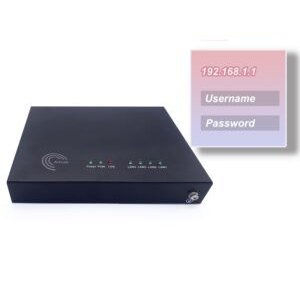
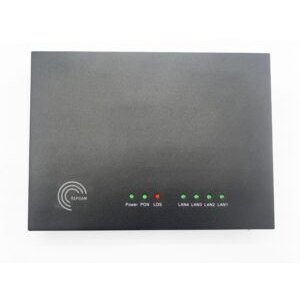
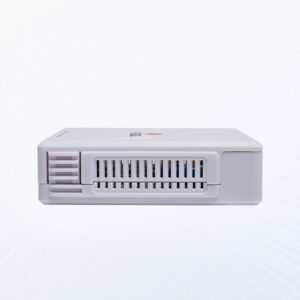
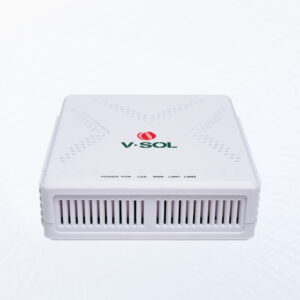
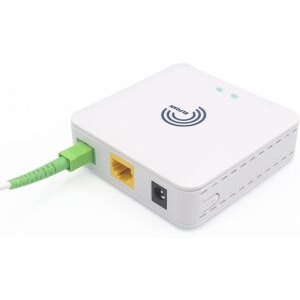
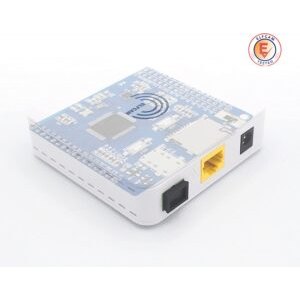
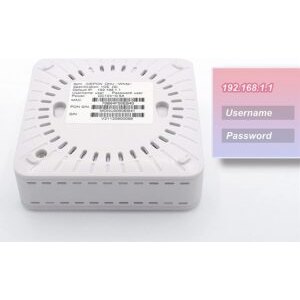
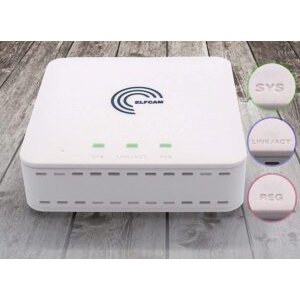
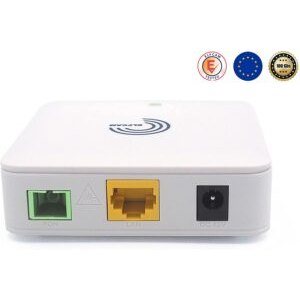
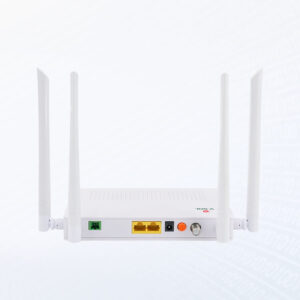
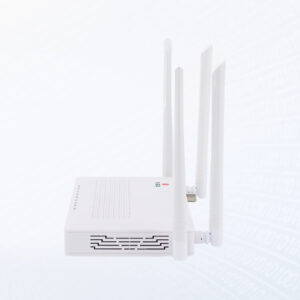
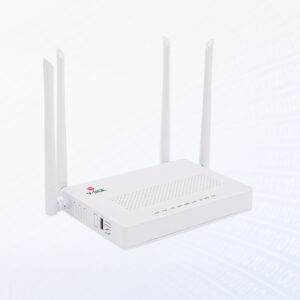
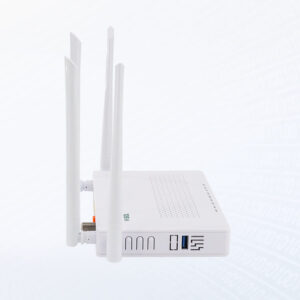
xPON (also written XPON or cross-PON) is a technology that integrates GPON and EPON into a single ONU device. It is not a new transmission standard, but a hardware and software solution providing dual compatibility.
How does automatic detection work?
- At startup, the xPON ONU listens to the network packets sent by the OLT
- If the frames match the GEM protocol → the ONU switches to GPON mode
- If the frames match the MPCP protocol → the ONU switches to EPON mode
- If no match is found, the ONU automatically restarts and tries the other mode
- Once the mode is identified, registration with the OLT is performed normally
On the hardware side, xPON is based on the GPON specifications (higher speeds, T-CONT QoS, multi-service support). The software provides the EPON compatibility layer. Result: a single ONU works with any OLT on the market, whether GPON or EPON.
Why choose xPON?
xPON offers concrete advantages for three categories of users:
For telecom operators in migration:
- EPON → GPON migration without replacing ONUs — subscribers equipped with xPON ONUs have nothing to do when the network is switched over
- Significant savings on equipment replacement costs: a deployment of 10,000 subscribers saves hundreds of thousands of euros in ONUs
- Simplified stock management — a single ONU reference for the entire fleet
For installers and integrators:
- Universal compatibility — a single ONU works with Huawei, ZTE, Nokia, Calix, Fiberhome OLTs and most brands on the market
- No stock errors — no more GPON vs EPON order mistakes on site
- Unified management platform — a single NMS (Network Management System) to supervise both types of network
For multi-site enterprises:
- A site using GPON and another using EPON can be equipped with the same ONU model
- Facilitates the standardization of network equipment across the entire property portfolio
- Reduced response times thanks to a unified spare parts inventory
Good to know
xPON also supports ATM, Ethernet and TDM services with strict QoS, as well as downstream CATV transmission via WDM — inherited from the GPON specifications on which it is based.
Real applications and deployments
xPON proves its relevance in four main contexts:
1. EPON to GPON transition (the main use case)
Many networks deployed in Asia in the 2000s–2010s rely on EPON. When increasing speeds (moving to GPON or XGS-PON), operators can keep the xPON ONUs at subscriber premises and simply replace the OLTs — reducing migration costs by 40 to 60%.
2. FTTH deployment in mixed environments
In large installations (buildings, campuses, industrial zones) where several OLTs of different generations coexist, xPON guarantees the compatibility of the entire ONU fleet without segmenting stock.
3. Residential FTTH — Freebox, Livebox, Bbox compatibility
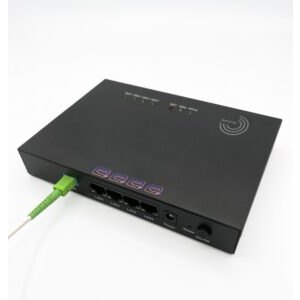
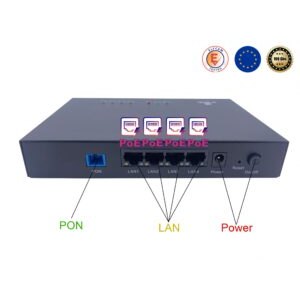
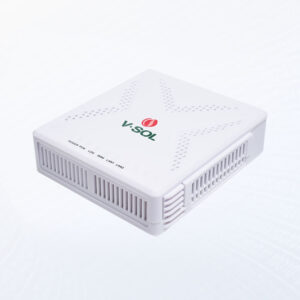
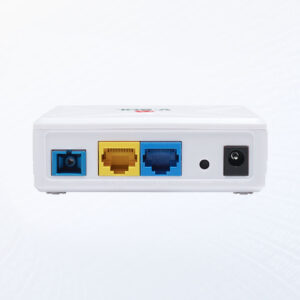
Compatible xPON ONUs are designed to work with the OLTs of the main French ISPs. A 1GE xPON ONU with SC/APC port can replace the ONT provided by the operator while remaining compatible if the infrastructure changes.
4. Multi-service enterprise networks
Thanks to ATM/TDM/Ethernet support and T-CONT QoS inherited from GPON, xPON is suitable for businesses requiring dedicated bandwidth guarantees (video conferencing, VoIP, real-time streams).