Custom optical fibers : overview of types by application
Contents
The optical fiber market was long dominated by a single type : the G.652 graded-index single-mode fiber, standardized by the ITU-T. This standard was sufficient as long as the work was long-haul transport in the telecom backbone.
With the explosion of applications — residential FTTH, high-density 100G/400G datacenter, transoceanic submarine cables, extended WDM links — one size no longer meets every need. This article reviews the main fiber variants optimized by application.
Each application has given rise to a suitable fiber type: bend-insensitive for the home, small-core for density, low-water-peak for CWDM, OM5 multimode for datacenter SWDM, hollow-core for ultra-low latency.
Why custom fibers ?
Fibers optimized for a specific application deliver measurable advantages :
- Bend-insensitive fibers — essential in indoor installations with right angles and tight cabinets
- Reduced fiber claddings — increase density in a multifiber cable (up to 3456 fibers in a 12 mm diameter cable)
- Low-water-peak fibers — enable CWDM multiplexing over 18 wavelengths between 1270 and 1610 nm
- Very low attenuation fibers — increase the spacing between amplifiers in long-haul telecom
- Graded-index multimode fibers — high data rates over short distance with inexpensive VCSEL transmitters
G.652: the historic single-mode standard
The ITU-T G.652 recommendation defines the graded-index single-mode fiber used since the 1980s. Characteristics :
- Core diameter : 8-10 µm
- Cladding diameter : 125 µm
- Nominal wavelength : 1310 nm (zero dispersion)
- Attenuation : 0.35 dB/km at 1310 nm, 0.22 dB/km at 1550 nm
Sub-classes :
- G.652.A/B — historic versions, no longer in production
- G.652.C/D — current low-water-peak versions, attenuation minimized at 1383 nm (E band)
Elfcam fibers recommended by application
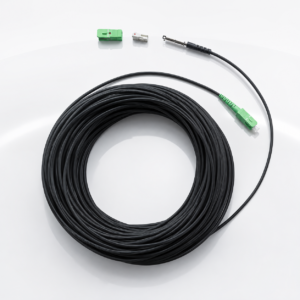
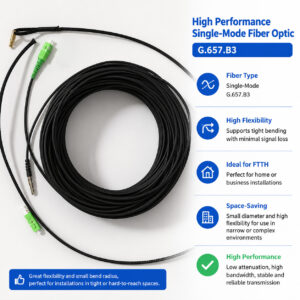
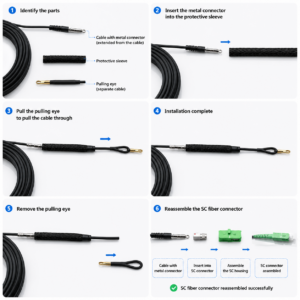
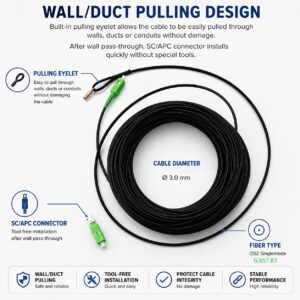
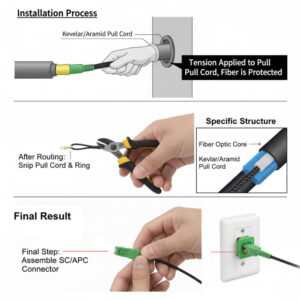
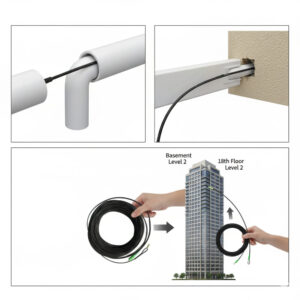
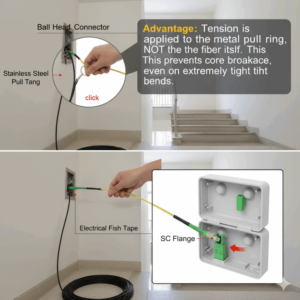
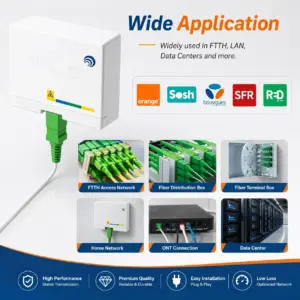
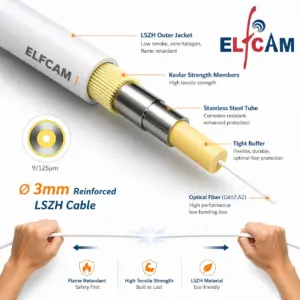
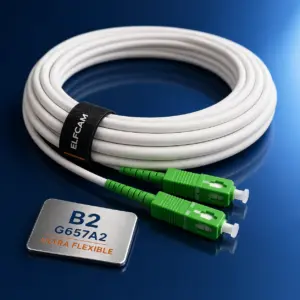
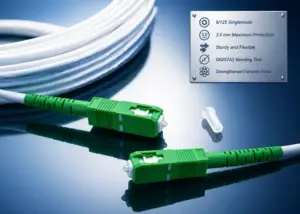
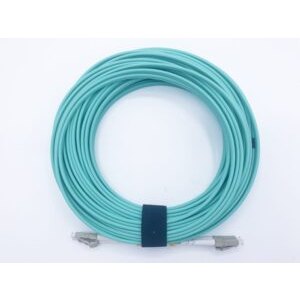
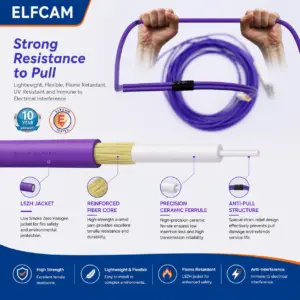
- Home FTTH — Ref 27261 G.657.B3 cable 50 m "Pull-Eye" with pulling eyelet
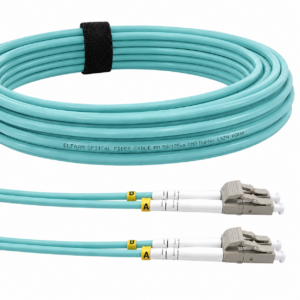
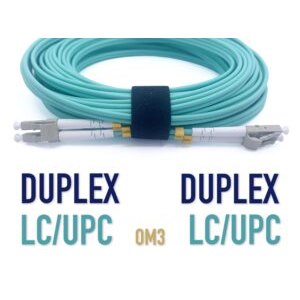
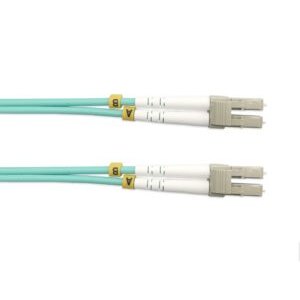
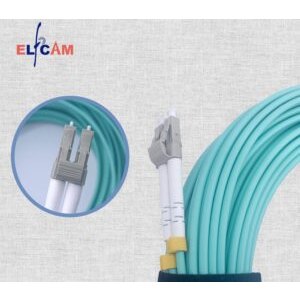
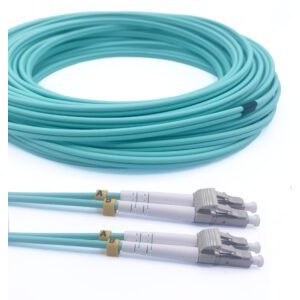
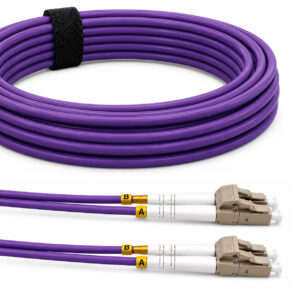
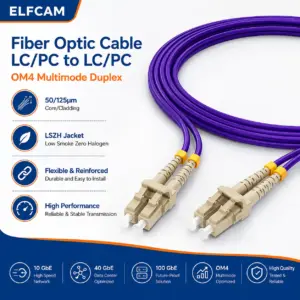
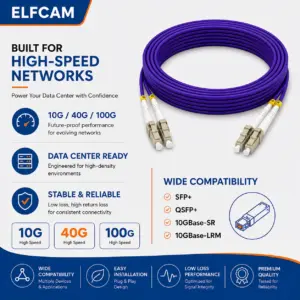
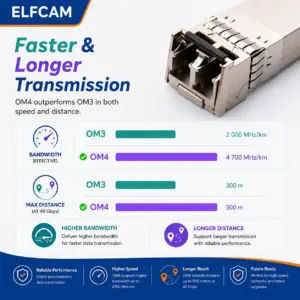
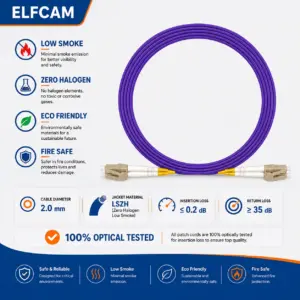
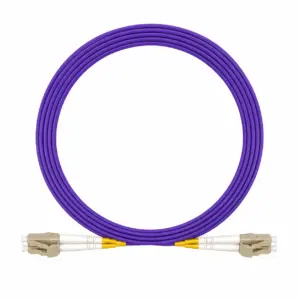
- Datacenter OM3/OM4 — Ref 400 LC/UPC multimode duplex 50/125 µm
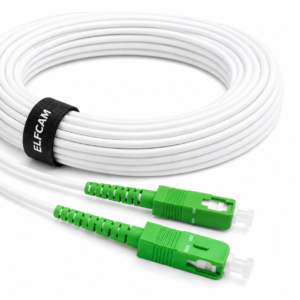
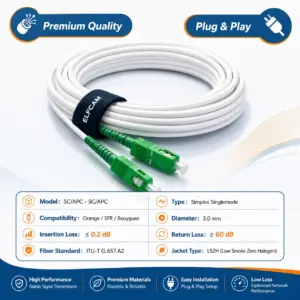
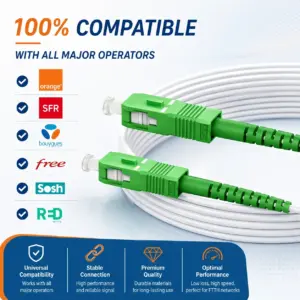
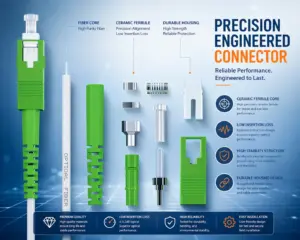
- Single-mode backbone — Ref 319 SC/APC armored reinforced, compatible with FR operators

Bend-insensitive fibers (G.657)
The G.657 standard defines bend-resistant fibers, essential for FTTH access in the home. Two classes :
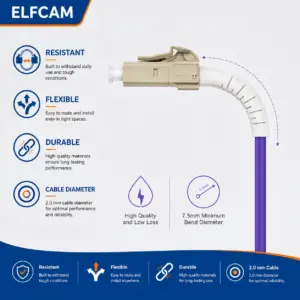
- G.657.A2 — bend radius 7.5 mm, 100% compatible with G.652
- G.657.B3 — bend radius 5 mm, optimized for tight installations
These fibers withstand bends that G.652 would not tolerate. See our complete guide on bend-resistant fibers.
Small-diameter fibers (80/170 µm)
By reducing the cladding from 125 → 80 µm and the coating from 250 → 170 µm, the glass volume is divided by 2.4. This increases the density of fibers in a cable :
| Fiber type | Core | Cladding | Coating | Application |
|---|---|---|---|---|
| Standard G.652 | 10 µm | 125 µm | 250 µm | Telecom reference |
| Thin coating | 10 µm | 125 µm | 200 µm | 1728-fiber cables |
| Reduced cladding | 10 µm | 80 µm | 170 µm | 3456-fiber cables |
The 3456-fiber cables are used in hyperscale datacenters (Google, Meta, AWS) for inter-building connection within a single modest-diameter cable jacket.
Low water peak fibers (LWPF / G.652.C/D)
Classic single-mode fibers exhibit an attenuation peak around 1383 nm (E band), due to residual hydroxyl OH⁻ ions in the glass. LWPF fibers (Low Water Peak Fiber) eliminate this peak thanks to advanced purification processes.
Benefit : possible use of the 18 CWDM channels between 1270 and 1610 nm (20 nm spacing), versus only 8-12 channels on a standard fiber. This is essential for CWDM metropolitan links and extended FTTH PON networks.
Graded-index multimode fibers (OM3 / OM4 / OM5)
Multimode fibers with a graded refractive index date back to the late 1960s. Today they are dedicated to short high-speed links (datacenter, campus) with inexpensive VCSEL (Vertical-Cavity Surface-Emitting Laser) transmitters.
| Type | Bandwidth | 10G reach | 40G/100G reach | Cladding color |
|---|---|---|---|---|
| OM1 (62.5/125) | 200 MHz·km | 26 m | Not supported | Orange |
| OM2 (50/125) | 500 MHz·km | 82 m | Not supported | Orange |
| OM3 (50/125) | 2000 MHz·km | 300 m | 100 m (40G) | Aqua |
| OM4 (50/125) | 4700 MHz·km | 400 m | 150 m (40G/100G) | Aqua/Violet |
| OM5 (50/125 WBMMF) | 28000 MHz·km | 400 m | 150 m (400G SWDM) | Lime green |
The OM5 (WBMMF, Wide Band Multi-Mode Fiber) standard is the recent evolution for SWDM (Short Wavelength Division Multiplexing) at 25 Gbit/s over 4 wavelengths between 850 and 953 nm. It also enables 400G multimode via IEEE P802.3cm.
When to choose OM5 over OM4 ?
If your datacenter plans a migration to 400G/800G over multimode within 2-3 years, OM5 is more future-proof. Otherwise, OM4 remains amply sufficient for 10G/40G/100G at a cost 20-30% lower.
Microstructured hollow-core fibers
Hollow-core fibers (HCF, Hollow-Core Fiber) are revolutionizing telecom by replacing glass with air in the core. Light then travels at 99.7% of the speed in vacuum, versus 67% in glass.
Concrete benefit : −33% latency per kilometer. On an inter-continental link, a gain of several milliseconds — decisive for high-frequency trading and edge computing applications.
Lumenisity (acquired by Microsoft in 2022) demonstrated in 2021 an HCF cable transmitting 10 Gbit/s in DWDM over 10 km — a commercial first. Corning and NKT are also developing HCF products for datacenter.
FAQ — Custom optical fibers
1Which fiber to choose for an FTTH installation ?
- Simple home, straight run → G.657.A2 (radius 7.5 mm, compatible with G.652)
- Moldings, right angles, tight cabinet → G.657.B3 (radius 5 mm)
2OM3, OM4 or OM5 for my datacenter ?
- OM3 — if you are on 10G/25G and do not plan a 40G+ upgrade within 5 years
- OM4 — current standard for 10G/40G/100G, excellent cost/reach trade-off
- OM5 — if you have a 400G multimode roadmap or SWDM needs
3Is an LWPF fiber (G.652.D) compatible with a G.652.A ?
4Can 80/170 µm fibers be used in residential FTTH ?
5When to use a hollow-core fiber ?
- High-frequency trading (HFT) between stock exchanges
- Low-latency edge computing
- 5G-URLLC (Ultra-Reliable Low-Latency Communication)
- Critical inter-datacenter links
6Can OM3 and OM4 be mixed on the same link ?
7Do OM5 fibers work with OM4 transmitters ?
8Where to obtain specialized fibers ?
- G.652 / G.657 / OM3 / OM4 — in stock at Elfcam, next business day shipping
- OM5 WBMMF — special order, 2-4 weeks
- LWPF G.652.D CWDM — special order for operator projects
- HCF hollow-core — only via Corning, NKT Photonics or Microsoft (Lumenisity)
In summary
Optical fiber is no longer a generic product. Each application has its optimal variant : G.657.B3 for FTTH, OM4 for the current datacenter, OM5 for future 400G multimode, LWPF for CWDM, small diameter for high density, HCF for critical latency.
Consult our catalog of optical fiber cables, SFP/SFP+ modules and adapters to find the solution suited to your project.